

In the modern digital age, the definition of “original work” has become increasingly complex. With a world of information available at the click of a button, university students face a double-edged sword: they have more resources than ever, yet they face stricter scrutiny regarding academic integrity and plagiarism.
Mastering the art of academic writing isn’t just about getting a grade; it’s about learning how to synthesize existing knowledge into new, unique insights. This guide explores the essential pillars of research, the mechanics of effective writing, and the technical skill of paraphrasing.
1. The Foundation: Strategic Research
Great writing starts long before you type the first word. The research phase is where most students either set themselves up for success or fall into the trap of “accidental plagiarism.”
Navigating Primary and Secondary Sources
To build a credible argument, you must distinguish between primary sources (original documents, data, or eyewitness accounts) and secondary sources (analysis or interpretation of those documents). A common mistake is over-relying on secondary sources, which can lead to a “telephone game” effect where the original meaning is lost.
The “Note-Taking” Barrier
The biggest red flag for academic integrity is poor note-taking. When you copy and paste text into your research notes without immediately citing the source, you risk forgetting that those words aren’t your own.
- Pro Tip: Use different font colors in your notes—one for direct quotes, one for your own thoughts, and one for summarized ideas.
2. The Art of Ethical Paraphrasing
Paraphrasing is more than just swapping words for synonyms. It is the process of internalizing a concept and explaining it in a way that reflects your own understanding.
Why Students Struggle with Rewriting
Many students fall into “patchwriting,” which is the act of mirroring the original author’s sentence structure while only changing a few words. This is often flagged by plagiarism software as a lack of original thought. To avoid this, you must learn to restructure the entire logic of a sentence.
For example, when dealing with dense technical jargon or complex theoretical frameworks, the pressure to be precise often leads to writer’s block. In these instances, utilizing a sophisticated paraphrasing tool from MyAssignmentHelp can serve as a powerful brainstorming aid. By seeing how a complex idea can be reconfigured into different linguistic structures, students can learn how to articulate their own arguments more clearly without losing the nuance of the original source.
The Three-Step Paraphrasing Method
- Read and Recite: Read the passage until you understand it fully, then look away and explain it out loud.
- Draft: Write your explanation without looking at the original text.
- Compare: Check your version against the original to ensure the “voice” is yours but the “fact” remains accurate.
3. Mastering Academic Voice and Structure
Once your research and paraphrasing are in order, the challenge shifts to the “flow.” An academic paper should read like a map, guiding the reader through a logical progression of ideas.
The Power of the PEEL Paragraph
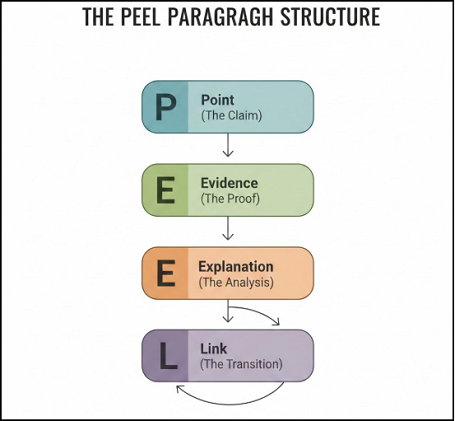
To ensure your writing remains focused and professional, utilize the PEEL structure for every body paragraph:
- Point: State the main idea of the paragraph.
- Evidence: Support the point with researched data or quotes.
- Explanation: Explain how the evidence proves your point.
- Link: Transition to the next paragraph or back to your central thesis.
Maintaining Objectivity
Academic writing requires an objective tone. Avoid “I think” or “I believe.” Instead, let the evidence lead the way. Use phrases like “The data suggests…” or “Current research indicates…” This shifts the authority from your personal opinion to the weight of your scholarly research.
4. Overcoming the “Deadline Crisis”
Even the best-intentioned students can find their academic integrity at risk when time runs out. When a student is overwhelmed by three different essays due in a single week, the temptation to cut corners or rush through citations becomes dangerously high.
This is where the concept of “academic support” becomes vital. Seeking professional assignment writing help is often a strategic choice for students who need a high-quality exemplar to understand how a specific topic should be structured. Rather than struggling in isolation, seeing a professionally drafted model can help a student understand the expected level of research, the proper application of referencing styles like APA or Harvard, and the correct way to synthesize complex arguments.
5. The Final Polish: Editing and Proofreading
A paper isn’t finished when the last sentence is written. The editing phase is your final safeguard against “technical plagiarism”—minor errors in citations that can lead to major academic penalties.
The “Reverse Outline” Technique
Read through your completed draft and write a one-sentence summary of what each paragraph says in the margin. If the summaries don’t follow a logical order, you need to rearrange your paragraphs. This ensures your argument is cohesive and robust.
Citation Check
Every fact that is not “common knowledge” (e.g., The Earth is round) needs a citation. If you are unsure if a fact is common knowledge, the safest rule of thumb is: When in doubt, cite it.
Conclusion: Writing for the Future
Academic integrity is not a set of rules designed to catch you; it is a framework designed to help you become a better thinker. By mastering the balance between original thought and respected research, you develop the critical thinking skills that are highly valued in the professional world.
About The Author
I’m Alexander Anderson, an academic consultant and lead researcher at MyAssignmentHelp. I specialize in helping students refine their writing and master complex research techniques. My work focuses on developing innovative educational resources, including our advanced paraphrasing tool, to help learners maintain academic integrity while achieving their peak performance.