
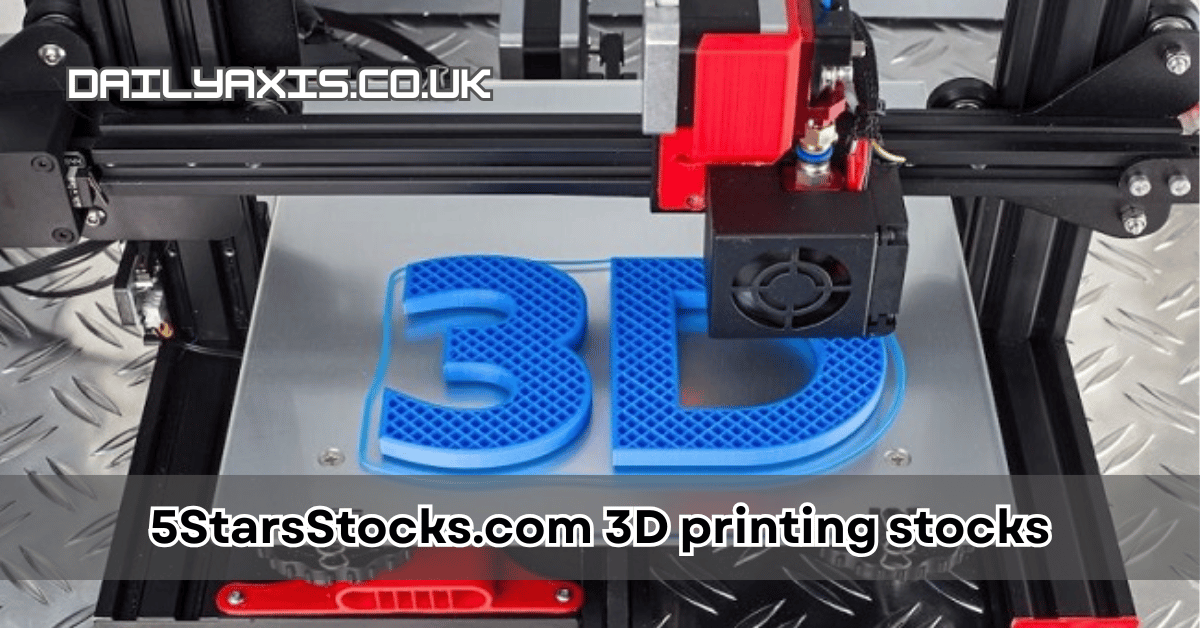
In an era where manufacturing is undergoing a seismic shift, the concept of additive manufacturing—commonly known as 3D printing—is rapidly becoming central to industrial disruption. For investors looking to ride this wave, understanding how platforms like 5StarsStocks.com 3D printing stocks work is key. This guide dives into the core of what 5StarsStocks.com offers, how it evaluates 3D printing companies, the major players in the sector, the risks and rewards, and how to use this insight to build a strategic investment approach. Whether you’re new to thematic investing or you’ve been tracking industrial-tech stocks for years, you’ll find value in exploring this intersection of platform analysis + emerging manufacturing dynamics.
What Is 5StarsStocks.com and Why Focus on 3D Printing Stocks
5StarsStocks.com positions itself as a modern investment advice platform that rates stocks across emerging sectors, including additive manufacturing. By using a “star” rating system, it aims to provide investors with quick, accessible signals—especially in areas like 3D printing stocks where traditional valuation metrics may lag innovation. The site typically evaluates companies based on growth potential, innovation pipeline, insider activity, institutional interest, and market sentiment.
Shifting the focus to 3D printing stocks makes sense when you consider that additive manufacturing is transitioning from prototyping to full-scale production across aerospace, healthcare, automotive and consumer manufacturing. The platform’s value lies in helping investors navigate that transition. 3D printing stocks by their nature are more volatile and innovation-driven than many legacy industrials; thus having a specialized lens such as 5StarsStocks.com can assist in separating hype from substance.
The State of the 3D Printing Industry
The 3D printing industry has evolved significantly over the past decade. What was once primarily limited to rapid prototyping has matured into production-capable processes, new materials (metals, composites, biomaterials), and manufacturing-on-demand models. Manufacturers are increasingly localizing production and using additive techniques to reduce waste and improve supply-chain resilience.
According to projections cited by several industry sources, the additive manufacturing market could surpass USD 50-60 billion by the early 2030s, with growth driven by industrial adoption, custom manufacturing, and digital workflows. These trends make 3D printing stocks intriguing—but the transition phase means many companies are still building scale, so investor patience and careful evaluation are essential.
How 5StarsStocks.com Analyzes 3D Printing Stocks
One of the core ways that 5StarsStocks.com differentiates itself is through a thematic focus and rating system tailored to emerging sectors like additive manufacturing. The platform typically uses a five-star scale evaluating criteria such as:
- Revenue growth and profitability potential
- Technology edge and IP portfolio
- Insider and institutional activity
- Market sentiment and investor crowd analytics
- Risk profile (volatility, competitive pressure, supply-chain constraints)
By applying these criteria to 3D printing stocks, the platform helps investors identify not just companies that benefit from additive manufacturing, but ones with structural advantages and scalable business models. The benefit here is clear: the 3D printing sector contains many speculative names, and a tool like 5StarsStocks.com offers a filtered view that aims to cut through the noise.
Major Players in 3D Printing to Watch
In the realm of 3D printing stocks, there are several companies frequently highlighted due to their technology, market position or growth potential. Some of the names covered in discussions about 5StarsStocks.com 3D printing stocks include:
- Stratasys Ltd. (SSYS): a pioneer in polymer additive manufacturing and a long-standing player in prototyping and production parts.
- 3D Systems Corporation (DDD): a broad additive manufacturing company offering printers, materials and services across various industries.
- Desktop Metal, Inc. (DM): focused on metal 3D printing, aiming to scale additive methods for manufacturing rather than just prototyping.
- Markforged Holding Corporation (MKFG): a company building advanced composite and metal printers, positioning itself for industrial workflows.
These companies illustrate different segments of the 3D printing market—polymers, metals, composites, services. When 5StarsStocks.com highlights 3D printing stocks, it often compares relative strengths in these sub-segments, pointing to where performance and scalability may emerge.
Growth Drivers Behind 3D Printing Stocks
Several factors are driving investor interest in 3D printing stocks, making platforms like 5StarsStocks.com increasingly relevant:
- Supply-chain shifts: After global disruptions, manufacturers are looking to localize production—3D printing enables that flexibility and responsiveness.
- Material advances: The development of new materials (metals, biomaterials, composites) expands the applications of additive manufacturing beyond prototypes into end-use parts.
- Customization and on-demand manufacturing: Industries like healthcare (custom implants) and aerospace (lightweight components) benefit from additive manufacturing’s strengths.
- Policy and infrastructure tailwinds: Governments renewing focus on domestic manufacturing and infrastructure may create indirect support for 3D printing stocks.
- Digital manufacturing and industry 4.0: Integration of software, data and additive hardware makes certain 3D printing companies more than just printer manufacturers—they become digital manufacturing platforms.
These growth drivers underscore why investors evaluating 3D printing stocks should consider long-term potential rather than short-term hype. Platforms like 5StarsStocks.com help clarify which companies align with these drivers.
Risks and Challenges Facing 3D Printing Stocks
Even as growth prospects are strong, investing in 3D printing stocks comes with notable risks. First, many companies are still scaling and may continue to post losses or low profitability for some time. Second, the sector is highly competitive: many firms vie for market share, and technological leadership can shift quickly. Third, supply-chain issues (materials, powders, precision components) can impact margins and timelines. Fourth, macroeconomic headwinds (e.g., manufacturing slowdowns) could pull demand for capital equipment like printers.
Platforms like 5StarsStocks.com attempt to quantify these risks via volatility scores, risk tiers, and scenario analyses. For any investor considering 3D printing stocks, it’s critical to balance optimism about the thematic tailwinds with discipline around valuations, timing and capital structure.
Building a Portfolio Strategy with 3D Printing Stocks
When including 3D printing stocks in a portfolio, the approach should reflect both potential upside and elevated risk. Some strategic steps include:
- Allocate only a portion of the portfolio to thematic or emerging tech stocks.
- Diversify across sub-segments (polymers, metals, services) rather than betting on a single company.
- Use tools and ratings (such as those from 5StarsStocks.com) to time entries and monitor sentiment shifts.
- Set realistic expectations: many 3D printing stocks may require a multi-year horizon to fully mature.
- Monitor business model transitions: look for companies moving from prototyping revenue to recurring production or service models.
This strategic mindset helps frame 3D printing stocks not as speculative lottery tickets, but as purposeful bets within a broader portfolio.
Evaluating Companies: Fundamentals, innovation and competitive edge
Beyond thematic promise, individual companies must stand up to scrutiny. Key evaluation dimensions include:
- Financial health: revenue growth, margin trends, profitability or path thereto.
- Innovation and IP: proprietary materials, unique printing methods, software integration.
- Market position and partnerships: strategic ties with major manufacturers, OEMs, aerospace/healthcare clients.
- Business model clarity: moving from hardware sales to recurring services, materials subscriptions, printers-as-a-service.
- Valuation vs growth potential: how much premium is being paid for future growth, and is that justified?
Platforms like 5StarsStocks.com help aggregate many of these data points, providing ratings and comparative benchmarks to assist investors in making more informed trade-offs.
The Role of Technology Trends in Shaping 3D Printing Stocks
Technology trends are central to how additive manufacturing unfolds—and consequently how 3D printing stocks behave. Some of the most important technology shifts include:
- Metal additive manufacturing becoming more cost-competitive with traditional processes.
- Multi-material and composite printing expanding application areas.
- Software, data and digital manufacturing platforms adding recurring revenue and higher margins.
- On-demand manufacturing and mass-customization enabling new business models.
- Sustainability and material-efficiency benefits becoming value drivers in regulatory or ESG-conscious markets.
For investors, tracking these tech trends helps identify which companies are well-positioned, and platforms like 5StarsStocks.com often highlight sub-segments or players aligned with these shifts.
Impact of Macroeconomics and Policy on 3D Printing Stocks
3D printing stocks do not exist in isolation—they are influenced by macroeconomic and policy factors. For example:
- Manufacturing investment cycles: downturns in industrial CAPEX can reduce hardware purchases.
- Supply-chain reshoring: policies supporting local manufacturing benefit additive process adoption.
- Trade and materials regulation: tariffs or materials scarcity can impact cost structures.
- ESG and sustainability mandates: companies offering reduced waste or energy-efficient manufacturing may gain strategic advantage.
- Interest rates and capital costs: emerging tech stocks may be particularly sensitive to rising rates because of reliance on future earnings.
Understanding how these forces influence 3D printing stocks and using a platform like 5StarsStocks.com to monitor catalysts and risks can improve investment timing and allocation decisions.
Practical List: Key Steps Before Investing in 3D Printing Stocks via 5StarsStocks.com
Here are actionable steps for investors interested in leveraging 5StarsStocks.com for 3D printing stocks:
- Define your investment horizon: e.g., 3-5 years vs short term.
- Use 5StarsStocks.com ratings to identify top-rated companies in the additive manufacturing space.
- Research the company’s business model: hardware, materials, services.
- Review recent earnings trends and growth metrics.
- Check for partnerships with large OEMs or industry leaders.
- Monitor sector-specific developments: new material launches, metal printing breakthroughs, customer wins.
- Assess valuation: compare P/E, EV/Revenue vs peers, and consider risk premium.
- Set exit criteria or stop-loss rules given the volatility in emerging tech stocks.
- Keep portfolio allocation modest for this thematic risk segment.
- Use 5StarsStocks.com educational tools (if available) to stay updated on sector changes.
This list gives a practical roadmap and turns thematic interest into actionable steps rather than mere speculation.
Table: Comparison of Leading 3D Printing Stocks
| Company | Ticker | Primary Focus | Strength |
|---|---|---|---|
| Stratasys Ltd. | SSYS | Polymer printers, prototyping | Long track record, materials depth |
| 3D Systems | DDD | Broad additive manufacturing | Full stack: printers, materials |
| Desktop Metal, Inc. | DM | Metal 3D printing | Strong growth potential |
| Markforged Holding | MKFG | Composite & metal printing | Niche, industrial applications |
This table provides a quick comparison of some key publicly traded names commonly featured in 3D printing stock discussions and platforms like 5StarsStocks.com.
Monitoring Trends, Sentiment and Platform Tools
One of the advantages of using a platform like 5StarsStocks.com is its sentiment and trend-monitoring capability. Emerging sectors like 3D printing are influenced not only by fundamentals but also by innovation sentiment, social media buzz, and emerging use cases (e.g., bioprinting, large-scale manufacturing). By tracking ratings updates, community sentiment overlays and thematic reports on 5StarsStocks.com, investors gain an early view of shifting dynamics. Regular readers of the platform may also benefit from alerts when a 3D printing stock moves from a four-star to five-star rating—or when industry catalysts (material breakthroughs, regulatory approval) hit the market.
Exit Strategy and Risk Management for 3D Printing Investments
When investing in 3D printing stocks through a thematic lens, an exit strategy and risk management plan are vital. Some key considerations include:
- Set predetermined profit targets or valuation milestones.
- Use stop-loss or trailing-stop rules given sector volatility.
- Reassess when star ratings change on platforms like 5StarsStocks.com—sometimes a downgrade signals underlying risk.
- Monitor news flow: product launches, material delays, competitive announcements can quickly affect valuations.
- Keep position size modest relative to total portfolio—emerging tech stocks shouldn’t dominate.
By combining rating signals from 5StarsStocks.com with disciplined exit and risk rules, investors manage the speculative nature of 3D printing stocks while capturing potential upside.
Conclusion
Investing in 3D printing stocks offers a compelling mix of growth potential and sectoral innovation. Platforms like 5StarsStocks.com 3D printing stocks provide a useful lens to navigate this dynamic space by offering curated ratings, thematic analysis and sentiment tracking. While the promise of additive manufacturing is real—from metals to polymers to customization—realizing upside requires patience, discipline and careful stock selection. Use the tools, stay informed, diversify, and keep a long-term view.
FAQs
What is 5StarsStocks.com?
5StarsStocks.com is a financial-research platform that evaluates stocks across emerging sectors, including 3D printing stocks, using a star-based rating system.
Are 3D printing stocks a good investment right now?
They carry high growth potential thanks to industrial adoption of additive manufacturing, but they also come with elevated risk and require a long-term horizon.
Which companies should I consider in the 3D printing sector?
Key names often referenced include Stratasys Ltd. (SSYS), 3D Systems Corporation (DDD), Desktop Metal, Inc. (DM) and Markforged Holding Corporation (MKFG).
How does 5StarsStocks.com help with selecting 3D printing stocks?
The platform provides thematic ratings, sector insights, risk metrics and sentiment data to help investors separate promising stocks from speculative ones.
What should investors be cautious about?
Volatility, supply-chain challenges, competition, valuation risk and the need for companies to scale from prototyping to production are major considerations.
Stay ahead with more insightful articles on Daily Axis.