
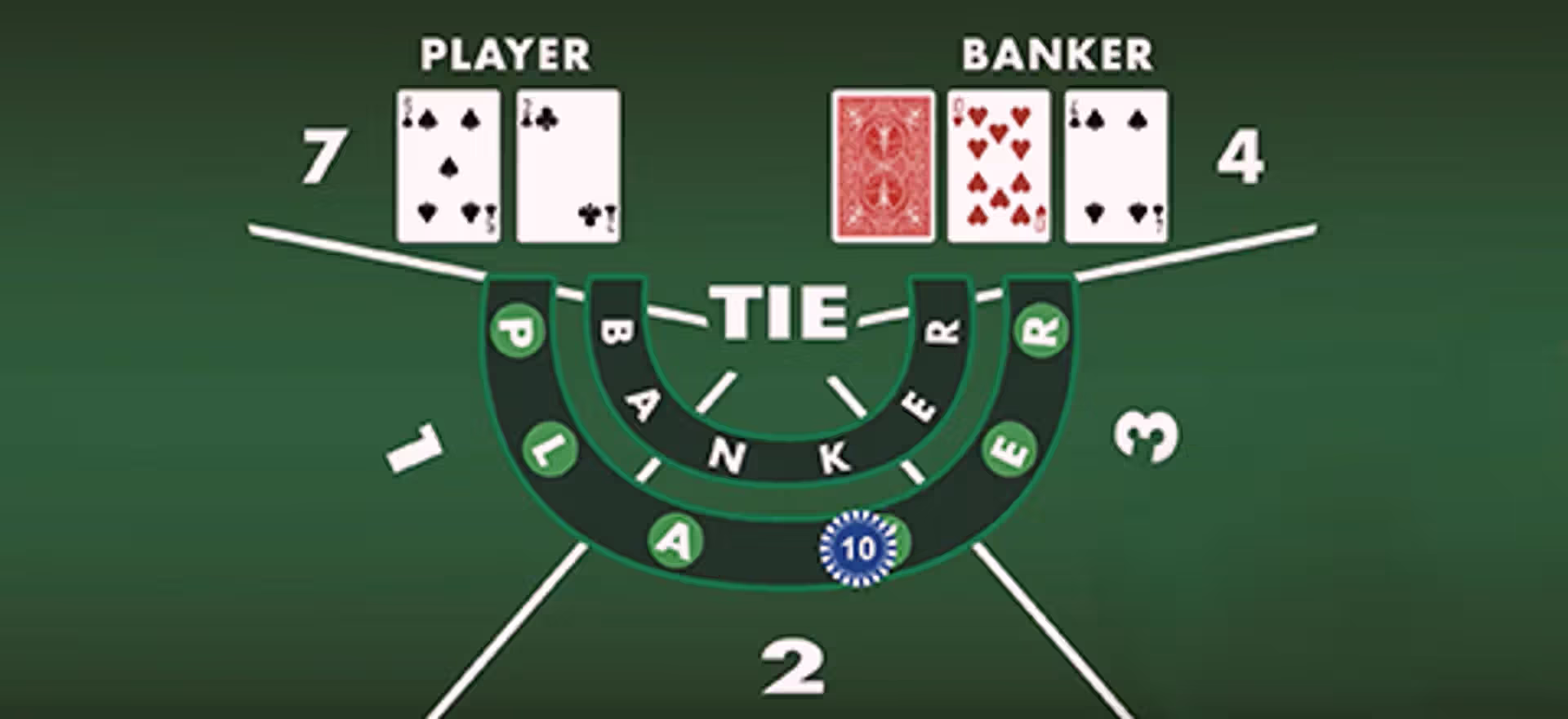
Baccarat is one of the oldest card games found in casinos, and its reputation as a game of high stakes and formal tables often hides how simple it actually is. Only three main outcomes exist: Player wins, Banker wins or the round ends in a Tie. Cards are drawn according to fixed rules, so no decisions are taken once the bet is placed. The entire strategic side of the game comes down to choosing which outcome to back and understanding the odds attached to each option.
The baccarat tables at atefia casino include digital versions as well as live-dealer studios, with classic, speed and no-commission formats available. All of them share the same core rules, and the differences between formats lie mainly in payouts on specific results and in the range of side bets offered. A clear picture of these rules and probabilities explains why baccarat has one of the lowest house edges in any casino lobby.
Card Values and Hand Totals
Baccarat uses a simple value system. Cards from 2 to 9 count at face value, aces count as one, and tens and picture cards count as zero. Hand totals are calculated by adding card values and keeping only the last digit. A hand made of a 7 and an 8 equals 15, which becomes 5. The highest possible total is therefore 9.
Each round starts with two cards dealt to the Player hand and two to the Banker hand. A total of 8 or 9 on the first two cards is called a natural, and when either hand shows a natural, both hands stand and the round is settled immediately. The names Player and Banker are labels for the two hands and do not refer to participants at the table. Bets can be placed on either hand regardless of who deals.
The Third-Card Rules
When neither hand has a natural, a third card may be drawn. The Player hand follows a short rule: it draws on totals from 0 to 5 and stands on 6 or 7. The Banker hand follows a more detailed rule that depends on its own total and on the value of the Player’s third card.
| Banker total | Banker draws when the Player’s third card is | Banker stands when the Player’s third card is |
| 0, 1, 2 | Any value | Never stands |
| 3 | 0 – 7 or 9 | 8 |
| 4 | 2 – 7 | 0, 1, 8, 9 |
| 5 | 4 – 7 | 0 – 3, 8, 9 |
| 6 | 6 or 7 | 0 – 5, 8, 9 |
| 7 | Never draws | Any value |
If the Player hand stands with two cards, the Banker hand draws on 0 to 5 and stands on 6 or 7. The dealer applies these rules automatically, and digital games handle them instantly. Knowing the table is not required to play, but it explains why the Banker hand wins slightly more often: it acts second and its drawing decisions take the Player’s third card into account.
Probabilities and House Edge of the Main Bets
The fixed drawing rules make every outcome calculable. The second table shows the figures for a standard eight-deck shoe, the most common format in online and live baccarat.
| Bet | Probability of the outcome | Standard payout | House edge |
| Banker | 45.86% | 1:1 minus 5% commission | 1.06% |
| Player | 44.62% | 1:1 | 1.24% |
| Tie | 9.52% | 8:1 | 14.36% |
| Tie (alternative payout) | 9.52% | 9:1 | 4.84% |
| Player Pair | 7.47% | 11:1 | 10.36% |
| Banker Pair | 7.47% | 11:1 | 10.36% |
When a round ends in a Tie, bets on Player and Banker are usually returned rather than lost. This is why the probabilities of Banker and Player add up to less than 100% without affecting their house edge in the way a loss would.
The Banker bet carries the lowest house edge of any standard wager. The 5% commission exists precisely because the Banker hand wins more often. Without it, the Banker bet would give the player side a mathematical advantage. Even after commission, the Banker remains marginally the better option in terms of expected return.
The Tie Bet
The Tie bet attracts attention with its high payout, but the figures show a different picture. At 8:1, the house edge exceeds 14%, more than ten times higher than the Banker bet. Some tables pay 9:1 on a Tie, which lowers the edge to about 4.84%, still far above the main bets. Over a long series of rounds, regular Tie betting raises the overall cost of play considerably.
No-Commission Baccarat
No-commission tables remove the 5% fee on winning Banker bets and compensate in a different way. The most common version pays only half the stake when the Banker wins with a total of 6. Under this rule, the Banker bet carries a house edge of about 1.46%, slightly higher than the classic version with commission. The Player bet keeps its usual edge of 1.24%, which makes it the lower-cost option at many no-commission tables.
Other variants exist as well. EZ Baccarat pushes Banker bets when the Banker wins with a three-card 7 and adds side bets such as Dragon 7 and Panda 8. These side bets pay 40:1 and 25:1 respectively, with house edges of roughly 7.6% and 10.2%. The rules of each variant are listed in the game information panel.
Speed, Squeeze and Live Formats
Format affects the pace of play more than the odds. Speed baccarat shortens betting time and can settle a round in under thirty seconds, roughly doubling the number of rounds per hour compared with a classic table. Squeeze baccarat slows the reveal, with the dealer gradually bending the cards before showing their value. This adds tension but does not change any probability.
The number of rounds per hour matters for overall cost. At the same stake and the same house edge, a faster table produces a larger total amount wagered per hour and therefore a higher expected hourly loss. A slower live table naturally limits that figure.
Scorecards and Patterns
Many tables display scorecards known as roads, such as the Big Road, Bead Plate and derived roads. These charts record previous results in coloured patterns and are a long-standing tradition of the game. Their value is purely historical. Cards are reshuffled or drawn from a large shoe, and each round is effectively independent. Streaks and patterns on the scorecards do not predict future outcomes, and no betting system based on them changes the house edge.
The same applies to progression systems that raise stakes after losses. These methods change the distribution of results but not the long-term expectation, and table limits prevent unlimited doubling.
Practical Conclusions
Several points follow directly from the mathematics of baccarat:
1. The Banker bet offers the lowest house edge at classic commission tables.
2. At no-commission tables with the half-payout rule on a Banker 6, the Player bet becomes slightly cheaper.
3. Tie bets and pair bets carry house edges many times higher than the main bets.
4. Faster formats increase hourly cost at the same stake.
5. Scorecards and patterns carry no predictive value.
Responsible Play
Baccarat combines simple rules with a low house edge, yet the casino retains a margin on every round. Short-term results remain highly variable, and long sequences of losing hands are a normal part of the game. Setting a session budget, using deposit limits and reality checks, and treating baccarat as paid entertainment keep play within safe boundaries. Gambling is permitted only for adults of legal age in the relevant jurisdiction.